What can ‘doubting’ Thomas teach us?
 In 2013 we moved to our electric current home, which was congenital in 1850 as a square farmhouse in what was then office of a rural village exterior Nottingham. One of the changes we made quite presently after moving in was to restore the historic kitchen garden, which had been planted over for the previous twenty or 30 years with copse and shrubs. The soil in the area is heavy clay, and in one bloom bed it feels as though you can actually dig up scarlet lumps and start making a pot straight away! But I have had no problem growing all manner of fruit and vegetables in the kitchen garden, since the surface area had cows and horses on information technology for a hundred years, and they have clearly made their contribution! In improver, there was an enormous well-rotted compost heap, and digging information technology out gave the whole area a three- or four-inch covering. Information technology is very fertile ground.
It feels as though this Sunday'southward lectionary reading, John 20.xix-31, is similarly rich, fertile and multi-layered, the historical base overlaid with the writer'southward reflections on the theological importance of what happened. Any number of theological reflections will apace grow up in this fertile ground—and hopefully comport fruit.
At that place seem to be ii major changes of gear in this passage from what has gone earlier. The first relates to time: in the get-go part of the affiliate, narrative time slows downwardly and then much that we are told who is running to the tomb fastest, and who enters in first, followed past the poignant account of Mary's encounter with Jesus. Here y'all can about count the passing seconds; it is all marked by the slowness and stillness of the early morn. By contrast, the second half of the chapter appears to be highly compressed, with a summary of Jesus' giving of the Spirit and commissioning the disciples, and a week skipping past in a moment. It is, one time over again, worth noting that this corresponds very well with the mode that we call back important experiences; the key moments are oft slowed downward in our memory, and details remain brilliant, long after we have forgotten other details, possibly even including what would otherwise be important details of chronology. (I tin can remember the colour of the car I was following on my wheel as a teenager when it crashed head-on with one coming the other manner; I tin can see the glass showering across the road and the noise, but I am blowed if I can tell you the month or even (reliably) the year.)
The second change of gear relates to the symbolic and theological meaning of this section. In the preceding passage, the typical symbolic double-meaning of much of the 4th Gospel has fallen away. Where Nicodemus' twilight of understanding matches the time of his visit to Jesus in John 3, and the bright noonday lite of John 4 expresses the Samaritan woman's recognition of Jesus, the deportment of Simon Peter and the other disciple don't announced to have whatsoever such significance. The disciple'south angle over to look in the tomb merely happens because that is what is required by the low entrance of any similar kickoff-century stone-cut tomb, as we know well from archeology. The separation of thesidarion that was wrapped around Jesus' caput from theothonia, the strips of linen wrapped around his body (John 20.vi–seven), is what you would only find if the body had passed through the textile and left them in their place—assuming y'all understood how bodies were prepared for burying in the first century.
Verse nineteen begins with one of the Fourth Gospel's customary mentions of timing, locating the encounter of the Ten (the Twelve without Judas or, on this occasion, Thomas) in the early moments of their receiving the news from Mary (John xx.18) and the other women. The news has not yet sunk in; they however remain behind locked doors for fear of theIudaioi, all-time translated here equally 'the Jewish [or Judean] leaders', since they however believe that they were next in line for the chop, as those whose power is threatened seek to snuff out this dangerous new movement. Some versions (like the NIV) draw the disciples as being 'together', simply at that place is no such give-and-take in the text; it is far from clear that they are, as a group, any less fragmented than when they were scattered by the crisis of Jesus' arrest (else why would Thomas be missing?). They are, by and large, in one concrete place just (in contrast to later occasions like Pentecost) information technology is far from clear that they are 'together'.
Despite the doors existence locked, Jesus comes and stands 'in their midst', a phrase which has a curious parallel with the vision in Revelation 1 of the Son of Homo 'in the midst' of the lamp stands (Rev i.13). In this passage, Jesus is both conspicuously corporeal (bodily) simply in a transformed way so that he is unconstrained by the limits of the concrete world, and can come and go as he pleases. Every bit in the parallel account in Luke 24.36, Jesus greets them and shows them his wounds; in that gospel, this everyday greeting becomes part of Luke's involvement in the theme of the peace of the gospel. But in the Fourth Gospel, the language of peace specifically reminds us of the Last Supper soapbox, in which Jesus offers peace in contrast with the 'trouble' his disciples volition have in the globe (John xiv.27, 16.33). On proverb this, he immediately shows them non his 'hands and feet' as in Luke, but his 'easily and side'. This confirms that it is the same Jesus they knew before, but also that it is these wounds that bring well-nigh the peace that he has promised. The springs of living h2o that Ezekiel predictable flowing from the side of the renewed temple (Ezekiel 47.1) really flowed from the side of Jesus (John 19.34), who is the true temple (John ii.19–21), in fulfilment of Jesus' own teaching (John 7.38). Joy comes to the disciples equally they begin to recognise who Jesus really is, and what his death and resurrection really mean.
The 2nd of three greetings of 'Peace…' moves the encounter on to its side by side stage. Jesus has not come simply to minister to them, but to commission them to minister to others in the aforementioned way he has ministered to them. 'Equally the Begetter has sent me, and so I send you'. There are two different words used hither for 'ship',apostello andpemporespectively, but there is no sense of unlike meaning. (The Fourth Gospel often uses synonyms with no differentiation of significant, the nigh celebrated and debated example being the different words for 'love' in John 21.) We then are offered a concise 'Johannine Pentecost' as Jesus breathes on the disciples and invites them to 'receive the Spirit'. I don't think there is any piece of cake mode to resolve the chronological differences between this and Luke-Acts; for the possible options come across Craig Keener's extended discussion in his commentary on John, pp 1196–1200. Buttheologically the Fourth Gospel says something very like to Luke:
Christology: As Jesus' breathing illustrates, Jesus is the one who dispenses the Spirit of God, a claim that thus enfolds Jesus within the Godhead (as Max Turner has argued in relation to Luke's account of the ascension and Pentecost).
Missiology: their apostolic ministry, sent to proceed the work that 'Jesus began to do' (Acts one.1), tin only be effective when empowered by the Spirit. Luke expresses this in the close linking of the Spirit, power, and testimony both in the ministry of Jesus and throughout Acts.
Ecclesiology: the realisation of the forgiveness that comes from Jesus' death and resurrection but takes identify in the context of this Spirit-filled resurrection community. Jo-Ann Brant (Paideia commentary, p 276–7) argues against the traditional agreement of John 20.23 as an 'antithetical parallelism', contrasting the forgiveness of sins with their 'retentiveness', is mistaken, not least because the word 'sins' is not repeated and the termkrateo ('retain') does non usually take such a negative connotation. A amend way of understanding the second phrase is the 'grasping' or 'retaining' of someone in the community, thus forming a synthetic parallelism between the forgiveness of sins and the building of customs: 'Whosoever'due south sins you forgive they are forgiven; and whosever you continue, they are kept.' (The verbkrateo is used of Jesus' grasp of theekklesiae, the believing communities, in Rev two.i.)
It is within the broad context of this rich tapestry of ideas that the narrative virtually Thomas comes. The others greet Thomas simply the same manner Mary had greeted them 'We take seen the Lord!', using exactly the aforementioned words—but the effect is quite dissimilar. Thomas' response is not rational but emotional; it is total of repetition (nails/nails, put my finger/put my paw) and drama, as he demands to merely to affect only to 'thrust' (ballo) his finger and hands in the gaping wounds. What was the reason for this bitter response?
A number of years ago, I was taking an assembly in a primary school, and asking the grouping to proper noun some of their heroes. Equally each one was mentioned, I exclaimed dramatically that I had only recently seen these people—some of them on the mode to school that morning—and if only I had known I could have brought them along or introduced them! In that location was growing incredulity in the grouping, and rightly so. But when I asked how they would feel if this had really happened—and so how Thomas might be feeling having missed out on the encounter—a hand at the back shot upwards. 'I would exist very angry!' Information technology was an amazing insight into the things that concord the states back from believing, and acrimony at what has happened to us and the manner life has turned out seems to me to be far more than mutual than an actual lack of evidence, even if it is evidential language that nosotros naturally attain for. (And I take ever since called the Twin 'Angry Thomas' rather than 'Doubting Thomas'.)
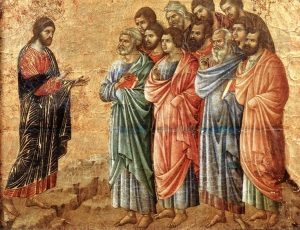
 Jesus' side by side appearance takes place 'subsequently eight days', which perhaps, by counting the days inclusively (that is, including the showtime and last within the number) means 'one calendar week later' every bit many English translations take it. This second run across at first exactly mirrors the first: the door are locked; Jesus stands in their midst; he greets them a third time 'Peace be with you!' So his attention is turned to Thomas, with two remarkable features. Commencement, the risen Jesus completely accepts Thomas' demands of proof, then that his invitation repeats exactly the language of finger and nails and hand and side that Thomas himself used. There is no sense in which Jesus requires belief as something contrary to or lacking in bear witness. The 2nd remarkable affair (contrary to this famous painting) is that in that location is no proffer that Thomas takes him up on the offer; seeing Jesus for himself is enough, as Jesus' following saying emphasises. Whatever Thomas' sin is (if that is what it be) is immediately forgiven, and he is again incorporated into the apostolic community.
This then leads into Jesus' saying itself, and the first concluding argument that the writer adds at the end of the chapter (the 2d final statement coming in John 21.24–25). Although in the narrative, Jesus is speaking to Thomas, in recording it the gospel writer is speaking to his audience, since 'those who take not seen, yet believe' are precisely the first generation of readers of this gospel—especially if it was written at the cease of the apostolic era, when the outset generation of middle-witnesses are passing away.
And we need to notation that those 'who have not seen' are not in any sense junior to those who 'take seen and believed'; it is the shared reality of conventionalities that matters. Where Thomas had the visual evidence of the Living Word before him, we now have the evidence of the written word, the testimony of the beloved disciple, and both are equally sufficient evidence for placing our trust in Jesus. In reflecting on our relationship to Thomas, we might want to borrow the language of the post-obit affiliate. 'Never heed about what I want for him—what matters is that you follow me.'
(Previously published in 2019)
If you enjoyed this, practice share it on social media, possibly using the buttons on the left. Follow me on Twitter @psephizo.Similar my page on Facebook.
Much of my work is washed on a freelance basis. If you have valued this postal service, would you considerdonating £i.20 a month to support the product of this blog?
If you enjoyed this, practise share it on social media (Facebook or Twitter) using the buttons on the left. Follow me on Twitter @psephizo. Like my folio on Facebook.
Much of my work is washed on a freelance basis. If you accept valued this post, you tin can make a unmarried or repeat donation through PayPal:
Comments policy: Proficient comments that engage with the content of the post, and share in respectful debate, can add real value. Seek starting time to understand, then to be understood. Brand the almost charitable construal of the views of others and seek to learn from their perspectives. Don't view debate as a disharmonize to win; address the statement rather than tackling the person.
martinezhiseens1942.blogspot.com
Source: https://www.psephizo.com/biblical-studies/what-can-doubting-thomas-teach-us/

ارسال یک نظر for "What can ‘doubting’ Thomas teach us?"